
What’s the Difference Between an Eating Disorder and Disordered Eating?
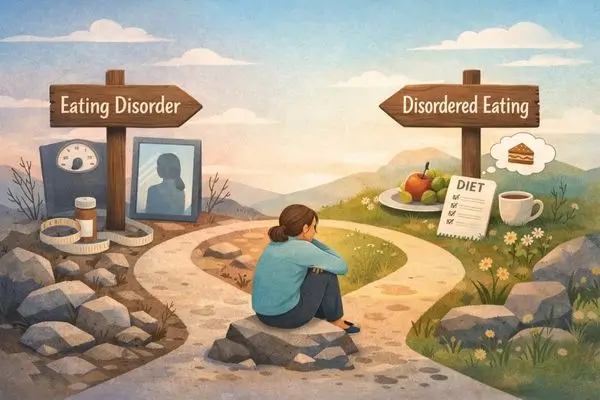
Nope, you’re not seeing double—this title is intentional. It’s a question that comes up a lot, and understandably so. “Eating disorder” and “disordered eating” sound so similar that it’s easy to assume they mean the same thing. But they’re not interchangeable. In fact, understanding the difference is incredibly important, especially when it comes to identifying struggles early and getting the right kind of support.
Let’s start with eating disorders
These are serious, complex mental health conditions that go well beyond the occasional diet or overeating episode. Eating disorders involve deeply rooted struggles with food, body image, and self-worth, often becoming all-consuming and leading to major emotional and physical consequences. According to the Mayo Clinic (2023) and Cleveland Clinic (2022), eating disorders can affect anyone—regardless of gender, age, or background. Common diagnoses include anorexia nervosa, bulimia nervosa, and binge eating disorder, each with distinct behaviors like extreme restriction, purging, or compulsive overeating (National Institute of Mental Health [NIMH], n.d.; American Psychiatric Association, n.d.). At their core, these disorders aren’t just about food—they’re often tied to underlying issues like trauma, anxiety, or low self-esteem (Healthline, 2021). That’s why early recognition and compassionate, professional help are so important (National Eating Disorders Association [NEDA], n.d.).
Now, let’s talk about disordered eating
This term refers to a range of irregular eating behaviors that may not meet the clinical criteria for an eating disorder, but can still be harmful. Things like chronic dieting, skipping meals, obsessively tracking calories, or using food to cope with stress might not qualify as a diagnosable condition, but they can still impact your health—both mentally and physically. NEDA describes disordered eating as a warning sign: while it may not be a full-blown eating disorder yet, it can easily evolve into one if left unchecked. Unlike eating disorders, disordered eating doesn’t follow strict diagnostic guidelines like those found in the Diagnostic and Statistical Manual of Mental Disorders (American Psychiatric Association, 2013), but that doesn’t make it less serious. In many cases, it reflects distress that deserves attention and care (Mayo Clinic, 2023; Cleveland Clinic, 2022).
Current Stats
What’s really eye-opening is just how widespread these struggles are. Nearly 29 million Americans—about 9% of the population—will experience an eating disorder in their lifetime (National Association of Anorexia Nervosa and Associated Disorders [ANAD], 2023). And disordered eating? It’s even more common. Some studies estimate that up to 50% of people engage in behaviors like dieting, skipping meals, or rigid eating patterns at some point (Cleveland Clinic, 2022; NEDA, n.d.). These habits are especially prevalent among adolescents and young adults, but they don’t discriminate—they affect people of all ages. Unfortunately, because of stigma or the belief that their problem isn’t “serious enough,” many people never seek the help they need.
The good news?
You don’t have to face this alone. Recovery is possible, and support is available. Whether someone is struggling with a diagnosed eating disorder or with disordered eating patterns, treatment can make a world of difference. Care often involves a team—mental health professionals, registered dietitians, primary care physicians, and sometimes psychiatrists (NEDA, n.d.; Mayo Clinic, 2023). In more severe cases, like with anorexia or bulimia, structured care such as outpatient therapy or residential treatment may be necessary (Cleveland Clinic, 2022). For disordered eating, early intervention through counseling and nutrition support can help prevent the development of more serious issues. Most importantly, getting help is about more than just food—it’s about healing your relationship with yourself.
First step toward healing
So if any of this sounds familiar—whether it’s about you or someone you care about—know that there is hope. Reaching out is a powerful first step toward healing, and you deserve support that truly honors your experience. Kristen Forman, LCSW—therapist and owner of Balanced Brain and Body—is here to help. With a compassionate, client-centered approach, Kristen works with individuals to heal their relationships with food, body, and self. Whether you’re navigating the challenges of an eating disorder or working through disordered eating habits, she can guide you toward lasting recovery and emotional well-being.
To take the first step, reach out today. Send me a message, call 201-564-0597, or email me kristenforman@balancedbrainandbody.com to schedule your 15-minute, complimentary consultation.
References
American Psychiatric Association. (2013). Diagnostic and statistical manual of mental disorders (5th ed.). https://doi.org/10.1176/appi.books.9780890425596
American Psychiatric Association. (n.d.). What are eating disorders? https://www.psychiatry.org/patients-families/eating-disorders/what-are-eating-disorders
Cleveland Clinic. (2022). Eating disorders: Types, causes, symptoms & treatment. https://my.clevelandclinic.org/health/diseases/4094-eating-disorders
Healthline. (2021). Eating disorders: Causes, symptoms, treatment. https://www.healthline.com/health/eating-disorders
Mayo Clinic. (2023). Eating disorders. https://www.mayoclinic.org/diseases-conditions/eating-disorders
National Association of Anorexia Nervosa and Associated Disorders (ANAD). (2023). Eating disorder statistics. https://anad.org/eating-disorders-statistics/
National Eating Disorders Association (NEDA). (n.d.). What is disordered eating?https://www.nationaleatingdisorders.org
National Institute of Mental Health (NIMH). (n.d.). Eating disorders. https://www.nimh.nih.gov/health/topics/eating-disorders
Teen Vogue. (2019). Eating disorders affect everyone, not just white women. https://www.teenvogue.com/story/eating-disorders-affect-everyone
Verywell Health. (2023). Understanding eating disorders. https://www.verywellhealth.com/eating-disorder-overview